Kneel: A Eucharistic Healing
by Michael Forrest
The following is my personal account of a day I will remember for the rest of my life. It occurred in the late spring of 1996. I have endeavored to be as plainly factual and objective as possible, while also conveying my subjective reactions at the time and in retrospect. While no one is obliged to believe what I am about to recount, I would only ask that one keep an open mind.
During my conversion from Baptist Protestantism to Catholicism, I underwent many challenges, and welcomed most of them. However, one difficulty I faced was particularly troublesome. In the process of my initial catechesis, I had not been sufficiently instructed in the Sacraments. As a result, I suffered unnecessarily in trying to comprehend these profound mysteries.
As a Baptist, I had been taught that the Lord's Supper (what Catholics call Holy Communion) was strictly symbolic. I was referred to Christ's words: "Do this in remembrance of me" (Lk. 22:19). I was assured that this scriptural passage was proof that the purpose of the Lord's Supper was only to remember what Christ had done for us on Calvary. This was my belief for almost 30 years. And as an analytical / rational sort, it certainly made sense. Why would anyone believe differently? The first time I heard that Catholics believe that the Eucharist is Christ's body, blood, soul, and divinity, I thought it was absolutely bizarre and idolatrous.
We should all frankly admit that this is very unusual and hard to accept. A quick reference back to John 6 will prove that the truth of the Eucharist has been hard to accept from the very beginning. Christ said, "Amen, Amen I tell you. Unless you eat the flesh of the Son of Man and drink his blood, you do not have life within you. Whoever eats my flesh and drinks my blood has eternal life, and I will raise him on the last day. For my flesh is real food and my blood is real drink. Whoever eats my flesh and drinks my blood remains in me and I in him" (Jn. 6:53-56). And afterwards, all of the people applauded and said, "Yes, of course! Brilliant! We believe, we believe!" Right?
Wrong. This is what happened: "Then many of his disciples who were listening said: 'This saying is hard: who can accept it?'" To which Jesus replied, "Does this shock you? What if you were to see the Son of Man ascending to where he was before?" In essence, I believe He was trying to get them to accept His difficult teaching on the Eucharist by telling them that they would see other astounding, miraculous things that they could neither explain nor deny (and, in fact, Jesus had already performed miracles). As such, He was asking them to suspend their intellectual disbelief in humble recognition that man is not always able to explain everything that God does or asks of us.
Yet, what does Scripture tell us many of these disciples did? Recall, these were not people who hated Jesus. They were disciples who believed and followed Him. "As a result of this, many of his disciples drew back and returned to their former way of life" (Jn. 6:66).
Now, we may want to reassure ourselves by thinking, At least the twelve Apostles understood what Jesus said and were perfectly comfortable with it. Or perhaps we might imagine that Jesus took them aside and said, Listen, these people didn't understand that I was speaking in parables! So relax, O.K.? And, actually, this latter point is exactly what Scripture tells us we would expect Him to do if He were speaking in parables and the Twelve did not understand. St. Mark writes, "With many parables he spoke the word to them as they were able to understand it . . . but to his own disciples he explained everything in private" (Mk. 4:33-34). So, was Jesus uttering a parable in John 6?
Well, fortunately, St. John recorded that private conversation Jesus had with the Twelve after speaking about eating His flesh and drinking His blood. And what did He say? Do we find a comfortable answer or an explanation of a parable? No. He simply said, "Do you also want to leave?" To which St. Peter replied, "Master, to whom shall we go? You have the words of eternal life." Not exactly a resounding affirmation. In essence, Peter seems to be saying, Well, I can't tell You that this makes complete sense to me, but we will believe it because we've come to trust You. We've thrown our lot in with You and have no better place to go.
I could go much further with this passage, explaining why I believe it so clearly supports the Catholic theology of the Eucharist, but that is not my intention here. I only intend to illustrate that belief in the Eucharist is really not natural. It is supernatural. In fact, in John 6, Christ also has this to say, "No one can come to me unless the Father who sent me draws him" (Jn. 6:44). Even faith is a gift from God (Eph. 2:8), and that necessarily includes faith in the Eucharist. The Church has given us noble, useful, and error-free explanations of the dynamics between free will and God's Providence, and the reality of the Eucharist. However, no human explanation, even though free from error, can approach the fullness of such realities, because they are divine, infinite mysteries.
Rational explanation alone could never hold a candle to the reality of the Eucharist or Divine Providence any more than it could ever approach the reality of the love between a husband and wife or a parent's love for his child. It is a mystery, and we have to disabuse ourselves of the notion that we can understand everything as though it were a math problem. It should also humble us, making us grateful that we have been given the gift of faith.
So, with that as a backdrop, let me return to the story.
Although I had officially come into the Church through Confirmation, I was still unsettled regarding the Eucharist. Yet, I "willed" myself to believe because I had done enough self-study to know that the Catholic Church was the only Church that could reasonably claim to have been established by Christ.
In a nutshell, after doing some self-study on the earliest years of the Church, I realized that the Church was very Catholic from the start in her beliefs and practices. The early Church clearly believed that the Eucharist was no mere symbol, but rather, the Real Presence of Christ in her midst. I could not reasonably accept that either the Apostles were incompetent teachers or that the Holy Spirit has so miserably failed in His job within the first generation or two after Jesus (Mt. 16:18; Jn. 14:16). Additionally, all of the Protestant Churches were created by
self-appointed human leaders between the mid-1500s to the present day. Essentially the Catholic Church was Christendom until then. Unless I was prepared to believe that no one really got it right until after the Reformation, I knew that the Catholic position was the only reasonable one. Catholics can trace every pope, bishop, and priest back through the laying on of hands (Holy Orders) to the Apostles and Christ.
Yet, I admit that I was still torn. Thirty years of reinforced belief do not easily give way. In my "gut," I still struggled. I was told the Catholic understanding was dangerous in my youth. My heart and my head were at war with each other. So I prayed that God would resolve and heal my interior division. My wife knew and prayed for me as well (she is a "cradle Catholic").
One Sunday we were preparing for Mass. My wife was in the rear seat, buckling our youngest child in our Dodge Caravan, and I was buckling our oldest son in the front seat. I was holding on to the center beam of the Caravan in order to balance myself as I leaned over to buckle him in. Unfortunately, my wife didn't see my hand. I suspect you're already cringing. Yes, you guessed it. From the inside she slammed the heavy sliding door shut across my fingers. And she slammed the door hard enough to lock it in place!
I immediately dropped to my knees and began yelling. I can recall almost "hearing myself," thinking, "Who is yelling like
that?" Then I realized it was I!
My wife was so distraught that she was unable to open the door from the inside, and so I was forced to pull myself up
and open the door with my other hand. The very tip of my pinky had been caught, my "ring finger" was caught about halfway to two-thirds
of the way up, and the top quarter of my middle finger had been injured as well. My ring finger seemed to have suffered the greatest
brunt of the blow.
Blood had been ejected through the skin, and was dripping down my palm from both my ring finger and my middle finger. All three fingers had been "flattened" from where they had been caught, up to the tips, and my ring finger and middle finger were about twice their normal width. Additionally, there was a deep crease on the back of the fingers from the edge of the door, and my ring finger, in particular, had been noticeably bent into the shape of the doorjamb.
Being a rational / scientific-minded person, I quickly assessed the damage (amid moans of pain) and asked my wife to call my brother and sister-in-law in order to drop our children off before heading to the emergency room. I was convinced that at least my ring finger was broken and possibly my middle finger as well.
After I had wrapped a paper towel and a red-and-white checkered face towel around my hand to stop the bleeding, a sudden "peace" and clarity came over me. Though I was in great pain, I could still think clearly somehow. I soon felt what I could only describe as a "compulsion" to pray. This may not seem unusual to many of you who pray very easily. But I assure you that at this point in my life, prayer was far from a typical response for me in such an emergency. And I felt that I needed to ask my wife to come pray with me as well.
When I asked her to pray with me, she gave me a mild look of disbelief and said, "What?" I repeated the request and
gently took hold of her arm and knelt to pray in our family room.
I prayed first that God would take away my wife's agony over causing my injury. As much pain as I was in, I could see
that she was suffering tremendously. Then I prayed that God would heal my hand and make sure that I could continue to play the piano
(I am a professional pianist / keyboardist).
Almost as soon as I stood up, I blurted out, "We're going to Mass anyway." I can still remember thinking to myself, "We
are? O.K., fine." At this point, I remember the look of dismay on my wife's face. Her expression conveyed that she thought I'd thrown a
blood clot from my finger straight to my brain. She said, "Michael, what is wrong with you? We have to get you to the hospital.
Your fingers are broken!"
I told her that I didn't really understand either, but that I was convinced that we needed to go to Mass regardless. After a milder protest, we returned to the van and dropped off the kids at my brother and sister-in-law's house. (I might add that they held their tongues very well when we told them we were running to Mass, not to the hospital. We didn't take time to explain, partly because I didn't understand myself. I'm not sure I would have been as understanding in their place. Sure, dump the kids on us just so
you can go to Mass!)
We were the very last people to arrive at church. We sat in the back. Keeping mild pressure on the wounds to stop the bleeding, I noticed that the pastor was speaking very forcefully and eloquently on the Real Presence of Christ in the Eucharist. In fact, I recall thinking that he sounded rather "Baptist" in his passion that day, which was very unusual for him. As I sat there in pain, my wife leaned over and said, "Isn't this what you've been praying
about, Michael?"
All of a sudden, I understood why I needed to be at this Mass. Somehow, I understood that God intended me to hear this
timely, impassioned sermon in order to dispel any lingering doubts and discomfort. I remember being thankful, telling God that I
believed completely now. I also asked forgiveness for my stubborn doubt.
When the time came, my wife, Paula, and I stood in line for Communion. I was the last person in line, with hand still
wrapped up and in pain. As we moved forward, I experienced something I had never experienced before or since. I "heard," almost as if the
word was implanted in my consciousness, "Kneel." I remember thinking, "Did I just think that?" At which point, the word repeated more forcefully, "Kneel." I got goosebumps.
There was no beatific vision, yet I cannot explain away the experience as self-induced. In fact, I recall that I didn't
understand initially. I thought, "Am I supposed to kneel right here?" Finally, I understood somehow that I was to kneel when
receiving Communion.
At this point, I leaned forward to my wife and whispered, "I think I'm supposed to kneel." Unfortunately, she thought I had said, "I think I'm supposed to yell." And she responded, "Oh, no, don't yell!" Even in my discomfort, I couldn't
help but to laugh a bit and said, "No, I said, 'kneel.'"
To this, she sighed with relief and said something to the effect of, "Well, hardly anyone kneels, Michael, but you can if you want to." I remember continuing down the aisle nervously, thinking, "I hope no one thinks I'm trying to be 'Mr. Pious and Holy' or something."
When I finally arrived in front of the pastor, he looked down with concern and curiosity at my red-and-white-towel-wrapped hand, as if to say, "What happened to you?" I sheepishly asked, "Is it O.K. if I kneel, Father?" He
replied, "Sure."
I knelt and received Communion. When I stood, I noticed a vague sensation of warmth, almost as if I had consumed the Precious Blood. Yet, I had only received the Sacred Host. On my way back to the pew, I kept my head bowed and eyes down. I assure you it was not out of piety, but rather out of mild embarrassment, not wanting to meet eyes with anyone who might be glaring at me.
When I arrived at our pew, I slid over and asked my wife for some clean tissues for my wounds. As I was taking the cloth towel and old paper towel off my hand, I leaned toward her, whispering how strange it was being told to "kneel" and how it seemed almost unreal.
As I finished speaking, I noticed Paula's jaw drop and eyes grow wide. She exclaimed in a whisper, "Oh my goodness, look at your hand!" I looked down, and to my amazement, my fingers were perfectly back into shape. When I looked over at her again, she said, "Look at the blood. It's disappearing!" Again, I looked down, and the blood that had collected under the surface of my skin appeared to be receding back into my fingers before our eyes, to the point where it was barely visible anymore.
I thought, "This is a miracle!" Then I thought, "If my fingers are really healed, I should be able to bend them without
pain." I hesitated very briefly and then bent them. There was no pain. I felt only a bit of a strange sensation, as if something
had happened, but nothing that could be described as "pain." (Looking back, I can't pinpoint exactly when the pain ceased.)
After almost everyone had left the Church, the pastor came down toward the rear of the Church, and Paula and I walked over to him. After I explained what had happened, he said, "You know, before Mass, I had a strong feeling that this homily was very important, and I wasn't exactly sure why. Now I know!" I thought I noticed his eyes watering a bit.
Shortly after, two older women from the parish came toward the three of us, and one gave me a hug. They said, "That was beautiful dear." I was rather sure they hadn't heard what I had said to the pastor, so I asked, "What was beautiful?" One responded, "When you knelt, that touched our hearts."
I told them that I didn't do it for show or anything like that, to which the other replied, "Oh, no, dear, we could tell
you were quite nervous! But we thought it was a wonderful gesture."
As the two ladies walked away, I noticed the pastor standing in a certain way, looking at me as if something was on his mind. I said, "What?" To which he said, "Don't you see what's going on here?" I said, "I know my hand was healed, Father."
The pastor then asked me if I knew what the day was. I admitted that I didn't other than that is was Sunday. He said, "This is the feast of Corpus Christi, Michael. It's all about the Real Presence of Christ in the Eucharist!" Then he continued, "What are the chances that you would have this happen right before Mass, that you would be the last one in line so that everyone would see you with that towel around your hand kneeling to receive? And what are the chances that this would all happen on Corpus Christi? This isn't just for you, this is for the Church, Michael."
We all hugged, and then Paula and I went to pick up our children. You see, we had a bit of explaining to do to my brother and sister-in-law.
As a final note, I would like to offer a few comments. First, I am not claiming to be saintly or anything of the sort. I sin every day to one degree or another (which my wife, Paula, can readily verify). Although I do sincerely try to improve with God's grace (most of the time), I don't delude myself for a second into believing that God gave me this gift because I'm a great guy. I believe he saw His child sincerely struggling, in need of some "remedial spiritual help," if you will.
Also, I did not speak about what had happened to anyone except my pastor and family for quite some time because I didn't want to give the impression that I thought I was "special" or any such nonsense. However, with time, others convinced me that I was still reacting as though it was "about me." In trying to be "modest," I had hidden a wonderful work that God had done. The fact is, it really isn't primarily about me. I know that. And just maybe, God knew that once I worked through that false humility, I would be the type who would be bold enough to let people know what He had done.
Last, I do not assert that everyone must kneel to receive Communion. The Church has allowed another choice at this time, and therefore I have no authority to say otherwise. Nevertheless, I am convinced that God intends for me to kneel when receiving. Furthermore, the Church has always taught that physical postures are very important, both in what they convey and in that to which they predispose the individual. Kneeling (traditionally either on both knees or on one's right knee) conveys worship and adoration and predisposes one's mind and soul to a
spirit of humble thanksgiving, while standing conveys honor and respect. One may honor and respect many things, yet there is only One to Whom worship and adoration are due. The Scriptures tell us, "As I live, says the Lord, every knee shall bend before me" (Rom. 14:11; Isa. 45:23).
Especially in these days, when belief in Christ's true presence, body, blood, soul, and divinity, are doubted by so many Catholics, I believe we must all thoughtfully and prayerfully consider our approach to the Eucharist, always reflecting on His infinite generosity to us. It is my fervent desire that we approach all of the Sacraments with a spirit of awe and thanksgiving. If this story helps toward that goal in any small way, it would be a great source of joy to me.
Michael Forrest is a Catholic apologist, and works with Priests for Life. He is also a composer and musician, and plays with his brother Sean Forrest in a contemporary Christian band (for information on the band, go to seanforrest.com).
© 2003 New Oxford Review, Inc.
This item 5864 digitally provided courtesy of CatholicCulture.org
Eucharist - Scriptural Notes
One loaf. Do we really understand?
The feeding of the five thousand is the ONLY miracle of Jesus that is recounted in all four gospels (Mt. 14:13, Mk. 6:41, Lk. 9:10, Jn. 6:11). The principal reason for that may be that it was seen anticipating the Eucharist and the final banquet in the kingdom, for example,
- Mt. 8:11 - I say to you, many will come from the east and the west, and recline with Abraham, Isaac, and Jacob at the banquet in the kingdom of heaven...
But it looks not only forward but backward to the feeding of Israel with manna in the desert at the time of the Exodus (Ex 16), a miracle that in some contemporary Jewish expectation would be repeated in the messianic age (2 Baruch 29:8). It may also be meant to recall Elisha’s feeding a hundred men with small provisions (2 Kgs 4:42-44).
But for the moment, let us focus on the gospel of Mark. In Mark we have a remarkable story of several trips that Jesus took across the Sea of Galilee. These trips encompass many miracles and the 2 miracle accounts of the feeding of the 5000 and the 4000. Familiarize yourself with the image below.
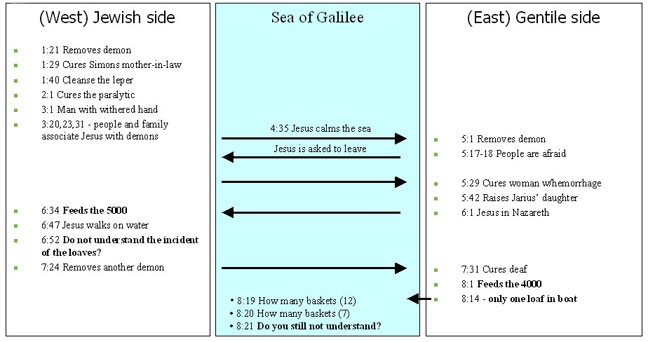
Here is a summary of this account from a book called “Mark’s Story of Jesus” by Wenner H. Kelber.
Mark narrates in 4:35-8:21 the elementary story of the communal dimension of the Kingdom, divided into two ethnic halves yet in the end united as one. To accomplish this unification, Mark uses the symbols of the lake, which serves as a barrier between the two sides; the two storm scenes, which dramatize the difficulty concerning the Gentile inclusion; the territories on either side, which signify Jewish and Gentile identities; the loaf and the loaves, which indicate unity and disciple’s failure to understand it; the boat, which functions as a vehicle of unification; and six boat trips, which impose a comprehensive logic upon the whole section. The boat trips, alternating between the two sides and giving each side due blessing and respect, dramatize a unitive movement. What happens as a result of these voyages is that the lake loses its force as a barrier and is transformed into a symbol of unity, bridging the gulf between Jew and Gentile. There is only one loaf, not two and not many. The human condition is no longer definable in pairs of opposition; contradictions and hostilities are overcome. That is fundamentally religious significance of the boat trip section. The Two are the One. The dimensions of the Kingdom are universal.
Mark’s concern for unity and equality extend to his treatment of males and females. It is difficult to overlook his effort to place males and females on either side of the lake so as to assure their equal standing in the new community. On the Jewish side the evangelist tells of a father and raising of his daughter (5:21-24, 35-42), as well as the healing of a woman (5:24-34). On the Gentile side he gives and account of a mother and her daughter (7:24-30), and two additional accounts each dealing with a male sufferer (5:1-20, 7:32-37). Males and females on the Jewish side are incorporated in the Kingdom of God.
Mark unifies and equalizes, but he does so at the expense of the disciples. It is the disciples (and not the Jews!) who in this section have emerged as the true opponents of Jesus. Their failure is epitomized in the concluding trip back to the Jewish side. The hardness of heart accusation, together with an entire lack of perception, reverses the disciples’ failure to grasp the logic of Jesus’ journey and are about to be an obstacle on the way to the Kingdom. The insiders have become opponents and outsiders.
The boat trip section leaves the reader with a question. Do the disciples understand or do they not understand the way of Jesus? As they embark together with Jesus on the road to Jerusalem, they leave without a proper understanding of the nature of the Kingdom and without memory of what Jesus had instructed them to do and to be.
Jesus was only kidding. Right?
Now let's turn our attention to the gospel of John which gives more explicit details. In the first few verses of John chapter 6, we learn that it was Passover time. John then recounts the feeding of the 5000 with the five barley loaves and the 2 fishes and because of this they said
- 6:14 - This is truly the Prophet, the one who is to come into the world.” Since Jesus knew that they were going to carry him off to make him a king, he withdrew again to the mountain alone. When it was evening , his disciple went down to the sea, embarked in a boat across the sea to Capernaum. I had already grown dark, and Jesus had not yet come to them. The sea was stirred up because a strong wind was blowing. When they had rowed about three or four miles, they saw Jesus walking on the sea and coming near the boat, and they began to be afraid. But he said to them, “It is I. Do not be afraid”. They wanted to take them into the boat, but they immediately arrived at the shore to which they were heading.
Once the people had found that Jesus and his disciples were not there anymore, they got into boats and went to Capernaum. But Jesus knew that they only came because they saw him feed the 5000 and not because they truly believed. And in v27 he tells them
- 6:27 - ...Do not work for food that perishes but for the food that endures for eternal life, which the Son of Man will give you...This is the work of God, that you believe in the one he sent”...
But they wanted a sign and Jesus referenced the manna that their ancestors ate in the desert. Jesus responds
- 6:35 - I am the bread of life; whoever comes to me will never hunger, and who believes in me will never thirst...For this is the will of my Father, that everyone who sees the Son of Man and believes in him may have eternal life and I shall raise him up on the last day.”
But the people murmured because he said I am the bread come down from heaven. Jesus repeats
- 6:47 - Amen, amen, I say to you, whoever believes has eternal life. I am the bread of life. Your ancestors ate the manna in the desert, but they died; this is the bread that comes down from heaven so that one may eat it and not die. I am the living bread that came down from heaven; whoever eats this bread will live forever; and the bread that I will give is my flesh for the life of the world.
So then the people are really confused because Jesus then follows these with statements
- 6:?? - Amen, amen, I say to you, unless you eat the flesh of the Son of Man and drink his blood, you do not have life within you. Whoever eats my flesh and drinks my blood has eternal life, and I will raise him on the last day. For my flesh is true food, and my blood is true drink. Whoever eats my flesh and drinks my blood remains in me and I in him...”
Are our eyes opened?
One last stop on our Scripture tour would be in Luke's gospel. In Chapter 24, Luke documents this wonderful event!
- 24:13 - Now that same day two of them were going to a village called Emmaus, about seven miles from Jerusalem. They were talking with each other about everything that had happened. As they talked and discussed these things with each other, Jesus himself came up and walked along with them; but they were kept from recognizing him.
He asked them, "What are you discussing together as you walk along?"
They stood still, their faces downcast. One of them named Cleopus asked him "Are you only a visitor to Jerusalem and do not know the things that have happened there in these days?"
"What things?" he asked
"About Jesus of Nazereth," they replied. "He was a prophet, powerful in word and deed before God and all the people. The chief priests and our rulers handed him over to be sentenced to death, and they crucified him; but we had hoped he was the one who was going to redeem Israel. And what is more, it is the third day since all this took place. In addition, some of our women amazed us. They went to the tomb early this morning but didn't find his body. They came and told us that they had seen a vision of angels, who said he was alive. Then some of our companions went to the tomb and found it just as the women had said, but him they did not see.
He said to them, "How foolish you are, and how slow of heart to believe all the prophets had spoken! Did not the Christ have to suffer these things and then enter into glory?" And beginning with Moses and all the Prophets, he explained to them what was said in all the Scriptures concerning himself.
As they approached the village to which they were going, Jesus acted as if he were going farther. But they urged him strongly, "Stay with us, for it is nearly evening; the day is almost over." So he went in to stay with them.
When he was at the table with them he took bread, gave thanks, broke it and began to give it to them. Then there eyes were opened and they recognized him, and he disappeared from their sight. They asked each other, "Were our hearts not burning within us while he talked with us on the road and opened the Scriptures to us?"
The next time you go to Mass, keep these Scriptures as a reminder. This is what we do every day of the week whereever a Catholic Mass is being said. The Scriptures are opened and explained to us. Then we give thanks and break bread. We follow the same model that Jesus did when he walked with the two on the road to Emmaus.
How was the Eucharist celebrated in the early church?
Private houses were the first centers of church life. Christianity in the first century A.D., and for long afterward, did not have the status of a recognized religion, so there was no question of a public meeting-place, such as the Jewish synagogue. So, the only facilities were the homes of the families that had become Christian.
Because only a certain number of members of “the whole church” (1 Cor 15:23) could regularly meet, it tended to be the family and friends of the household that was used. Although this fostered and intimate family atmosphere, this also promoted division. Due to the relative isolation each group had a chance to develop its own theology and virtually insured that it took good root before being confronted by other opinions. It seems likely then that the various groups Paul mentions (1 Cor 1:12- “I belong to Paul...to Apollos...[to] Cephas...to Christ” were probably members of these individual groups.
If you study the types of houses at this time you would find that there was a dining room and an courtyard (Atrium) where believers could gather in these homes. Since not all the believers could gather in the dining room the overflow would gather in the courtyard. The host then had to divide his guests into two categories; the first-class believers and the rest who stayed outside. The host must have been a wealthy member of the community to have such a house and so his closest friends among the believers who have the same social class would be invited into the dining room. Those in the dining room would have reclined as was the custom (see 1 Cor 8:10) and as Jesus always did with his disciples, whereas those in the courtyard had to sit.
This could be a reason for the tensions in Paul’s account of the eucharistic liturgy at Corinth (1 Cor 11:17-34). If there truly was this division of the “have” and “have-nots” who in their hunger had to content themselves with the bread and wine provided in the Eucharist, then Paul has gone to great lengths to point out that under such conditions no Eucharist is possible (v20). (v21) suggests that were made worse by the type of food offered. Since Corinth had been a Roman colony, it is possible that certain customs were retained. In this case, different food was offered to different categories of guests. Since the hosts friends were most likely of the leisure class, they could arrive early and feast on larger portions of superior food while awaiting the arrival of lower-class believers who were not as free to dispose of their time. The condition of those reclining gorged in the dining room could hardly go unnoticed from those who had to sit in the courtyard. Though still hypothetical, what else could explain Paul’s admonition to “wait for one another” (v.34).
Early Church Fathers on the Eucharist
Until the Reformation, all Christianity accepted the Real Presence of Christ in the Eucharist.
Even Martin Luther affirmed the doctrine.
"Who, but the devil, hath granted such a license of wresting the words of the holy Scripture? Who ever read in the Scriptures, that my body is the same as the sign of my body? or, that is is the same as it signifies? What language in the world ever spoke so? It is only then the devil, that imposeth upon us by these fanatical men". Not one of the Fathers, though so numerous, ever spoke as the Sacramentarians; not one of them ever said, It is only bread and wine; or the body and blood of Christ is not there present. Surely it not credible, nor possible, since they often speak, and repeat their sentiments, that they should never (if they thought so) not so much as once, say, or let slip these words: It is bread only; or the body of Christ is not there, especially it being of great importance, that men should not be deceived. Certainly in so many Fathers, and in so many writings, the negative might at least be found in one of them, had they thought the body and blood of Christ were not really present: but they are all of them unanimous."
(LUTHER'S COLLECTED WORKS, Wittenburg Edition, no. 7, p. 391).
Note that all the Churches that broke away before the Reformation (Orthodox, Coptic, Armenian) still believe in the Real Presence.
St. Ignatius of Antioch, a disciple and contemporary of the Apostle John, wrote (around 110 A.D.) concerning certain heretics: "They abstain from the Eucharist and from prayer, because they do not confess that the Eucharist is the Flesh of our Savior Jesus Christ, Flesh which suffered for our sins and which the Father, in His goodness raised up again."
In another letter St. Ignatius writes, "I desire the Bread of God, which is the Flesh of Jesus Christ � and for drink I desire His Blood, which is love incorruptible."
St. Justin Martyr wrote in his apology to the emperor at Rome (around 150 A.D.): "We call this food Eucharist; and no one else is permitted to partake of it, except one who believes our teaching to be true�For not as common bread nor common drink do we receive these; but since Jesus Christ our Savior was made incarnate by the word of God and had both flesh and blood for our salvation, so too, as we have been taught, the food which has been made into Eucharist by the Eucharistic prayer set down by Him, and by the change of which our blood and flesh is nourished, is both the Flesh and the Blood of that incarnated Jesus."
St. Irenaeus, bishop of Lyons and a pupil of St. Polycarp who had been taught by St. John the Apostle, wrote (around 195 A.D.): "He [Jesus] has declared the cup, a part of creation, to be His own Blood, from which He causes our blood to flow; and the bread, a part of creation, He has established as His own Body, from which He gives increase to our bodies."
St. Cyril of Jerusalem, in a catechetical lecture given in the middle of the fourth century (350 A.D.), said: "Do not, therefore, regard the bread and wine as simply that; for they are, according to the Master�s declaration, the Body and Blood of Christ. Even though the senses suggest to you the other, let faith make you firm. Do not judge in this matter by taste, but be fully assured by the faith, not doubting that you have been deemed worthy of the Body and Blood of Christ."